




About Author


Tom Claridge
November 23, 2026
Welcome to Hoxton Wealth, the new home of Hoxton Capital
Hoxton Blog • Signs of long term value emerging through the mist of short term volatility.
Even the biggest stock market debut in history wasn't enough to lift markets this week.
Artificial intelligence company Anthropic raised $81.3bn when it listed on the stock market, beating the record set by SpaceX in June. Its shares were priced at $83 and finished their first day of trading at $97.17, a rise of 17%.
But the wider market remained under pressure. The S&P 500 fell 5.1% over the week, leaving it up just 4.8% since the start of the year.
Investors are becoming increasingly concerned about economic growth and higher interest rates. While these worries are understandable, the recent falls may also be creating opportunities for long-term investors.
There are two main reasons behind the recent weakness.
The first is concern about economic growth, particularly whether companies will continue spending enormous sums on artificial intelligence infrastructure. Any slowdown could affect the technology businesses that have benefited from this investment, with consequences for the wider market.
The second is interest rates. The US Federal Reserve and other central banks are continuing to raise rates, and markets now expect borrowing costs to remain higher than previously anticipated.
In July, investors expected the Fed's interest rate to reach 3.94% by July 2027. That expectation has now risen to 4.52%.
Higher interest rates make borrowing more expensive, potentially slowing economic activity and putting pressure on company profits. Combined with concerns about weaker growth, this helps explain why investors have become more cautious.
The S&P 500 Has Given Back Some of Its Gains This Year. Year-to-date change, %. Source: Hoxton Wealth, Bloomberg
Markets Now Expect Higher US Interest Rates. Path implied by fed funds futures, %. Source: Hoxton Wealth, Bloomberg
Not every part of the stock market has been affected equally.
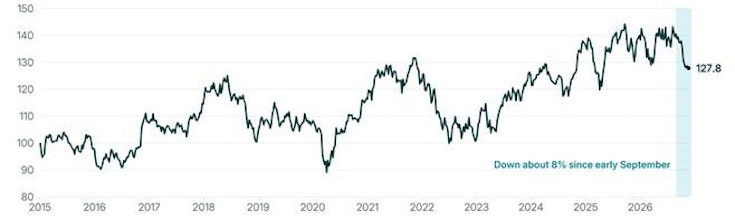
Companies whose fortunes depend heavily on economic growth have suffered some of the biggest falls. These include industrial businesses, materials producers, financial companies and businesses selling non-essential consumer goods and services.
Since early September, these sectors have performed around 8% worse than more defensive areas of the market.
Defensive businesses, such as utilities and companies selling everyday essentials, tend to be less affected by economic slowdowns because demand for their products and services remains relatively stable.
The difference in performance reflects growing concerns about the outlook for growth, with investors favouring businesses they believe are better placed to withstand a slowdown.
Companies Most Exposed to Economic Growth Have Suffered More. Sensitive ÷ defensive, equal-weighted S&P 500 sector indices, 2015 = 100. Source: Hoxton Wealth, Bloomberg
Despite the recent weakness, there are some encouraging developments.
One is the sharp fall in oil prices. Brent crude has dropped around 22%, from $118 a barrel at the end of October to approximately $92.
Lower energy costs can help ease inflationary pressure, potentially reducing the need for central banks to keep raising interest rates.
Longer-term inflation expectations have also remained relatively stable. A widely followed measure of expected US inflation over the next 10 years remains at a little over 2%.
This suggests investors do not expect inflation to remain persistently high and supports the view that the Fed may not need to raise rates much further.
Of course, markets will still need time to adjust to higher borrowing costs and uncertainty about economic growth. But these developments suggest some of the pressures weighing on share prices could begin to ease.
Falling Oil Prices Could Help Ease Inflation. Brent crude oil, $ per barrel, weekly. Source: Hoxton Wealth, Bloomberg
Long-Term Inflation Expectations Remain Stable. US 10-year breakeven inflation, %, weekly. Source: Hoxton Wealth, Bloomberg
While there are reasons to be encouraged, we should not expect the next few months to be plain sailing.
Higher interest rates and inflation at current levels can both weigh on investment returns. It also takes time for changes in monetary policy to affect the economy, so we may not yet have seen their full impact.
Further market falls are therefore possible.
However, volatility is a normal part of investing. Since 1950, the S&P 500 has experienced numerous declines of varying sizes, even as the market has delivered substantial returns over the longer term.
We are not short-term traders, and we do not believe investors should try to predict every market rise and fall. Getting those decisions right consistently is extremely difficult, and attempting to do so can mean missing out when markets recover.
Instead, our focus is on the longer term and whether current share prices offer attractive opportunities for the years ahead.
Market Falls Are a Normal Part of Investing. Total number of drawdowns in the S&P 500 since 1950, by size of drawdown (%). Source: © Exhibit A, FactSet Research Systems Inc., Standard & Poor's
One of the most important developments in recent weeks is that shares have become considerably cheaper.
When assessing whether a market is expensive or cheap, we look at how much investors are paying relative to the profits companies are expected to make. This is known as valuation, and it plays an important role in determining potential long-term returns.
Put simply, the less you pay for a company's future earnings, the greater the potential for attractive returns, assuming those earnings materialise.
The recent market falls have brought valuations down to levels not seen for several years.
The S&P 500 is now trading at 17.2 times expected earnings over the next 12 months, its lowest valuation on this measure since early 2023.
The Nasdaq, which has a greater concentration of technology companies, is trading at 17.8 times expected earnings, its lowest level since 2020.
These are meaningful changes. Investors are now paying considerably less for companies' anticipated profits than they were previously.
Of course, lower valuations do not guarantee an immediate recovery. Prices could fall further, particularly if economic conditions deteriorate and companies earn less than expected.
But the price paid for an investment has a significant bearing on its long-term return potential. Lower valuations can therefore make future returns more attractive, even when the immediate outlook remains uncertain.
Share Valuations Have Fallen Significantly. Price ÷ expected earnings over the next 12 months, weekly. Source: Hoxton Wealth, Bloomberg
The recent market falls are understandably unsettling, and further volatility would not be surprising.
But focusing exclusively on short-term movements risks overlooking some important developments.
Oil prices have fallen, longer-term inflation expectations remain contained, and shares are trading at more attractive valuations than they have for some time.
The best investment opportunities do not necessarily appear when the economic outlook feels comfortable. Often, prices become more attractive precisely because investors are worried about what might happen next.
That does not mean every market decline is a buying opportunity or that we should ignore the risks.
We cannot predict when markets will recover, and there may be further setbacks along the way. But while the short-term outlook remains uncertain, we believe the recent fall in valuations has improved the opportunities available to patient, long-term investors.
If you would like to arrange a review of your investments, please contact us at client.services@hoxtonwealth.com or via our dedicated WhatsApp number: +44 7384 100200.
Important Disclaimer
This article is provided for general information purposes only and does not constitute personal financial advice or a recommendation to buy, sell or hold any investment. The views expressed reflect market conditions at the time of writing and may change without notice.
Investments can fall as well as rise in value, and you may get back less than you originally invested. Past performance is not a reliable indicator of future results, and there is no guarantee that any forecasts or expectations will be realised.
Investment decisions should take account of your individual financial circumstances, objectives and attitude to risk. You should seek professional financial advice before making any investment decisions.
If you would like to speak to one of our advisers, please get in touch today.
Tom Claridge
November 23, 2026
We are available to discuss how Hoxton Wealth can help you achieve your financial goals. Together, we can help you build a brighter financial future.

